
Home / Insights / Articles / Beyond The Title
AI Is Easy. Data Is Still Hard (Or Is It?) Let Me Explain
Episode 004 of Beyond The Title. Taking leadership to another level when AI is involved.
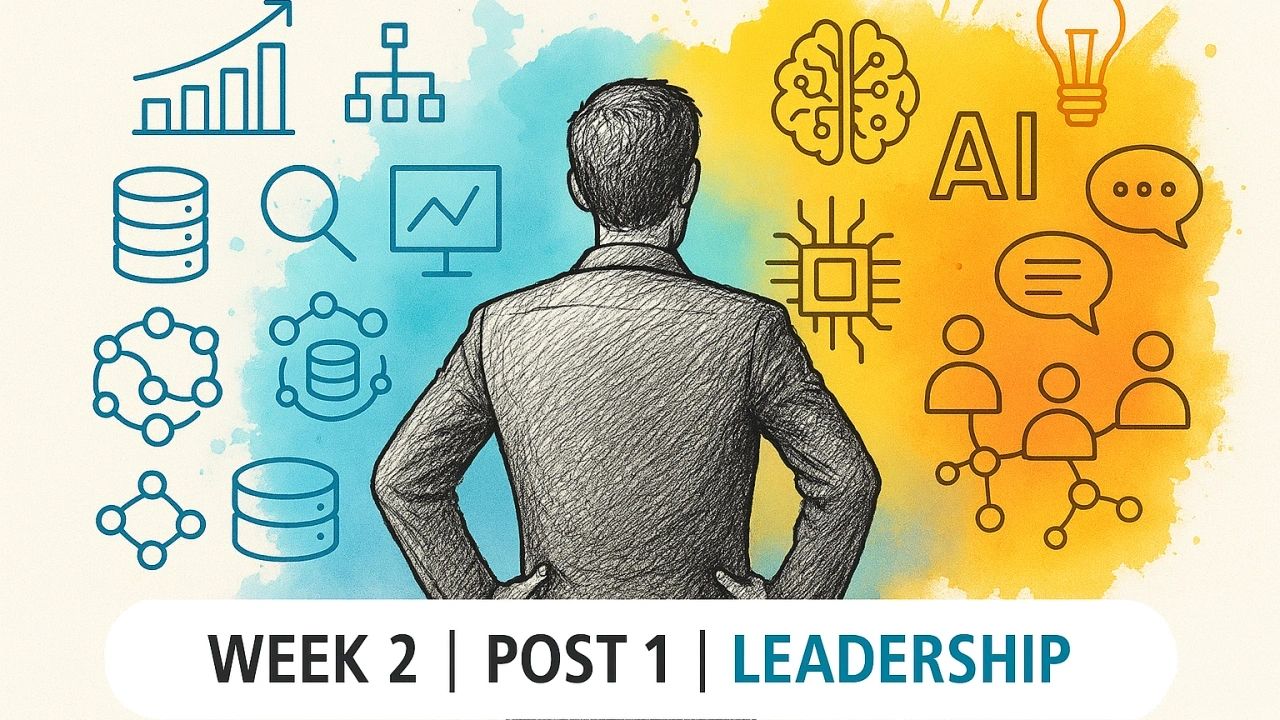
This article is about taking Leadership to another level when AI is involved.
Before We Dive In
Let’s be honest- AI’s the buzzword of the moment. Every boardroom’s talking about it, every vendor’s promising it, and every exec has it in their deck.
But the real conversations…
The ones about what it actually takes to make AI useful…
Still too few and far between.
I’m not writing this from a pedestal. I’m writing it because I’ve been sat in the middle- helping exec teams shape their vision while translating the reality of what sits underneath it. Data. Unseen, unloved, inconsistent data. And no amount of AI hype papers over that.
I’ve worked across the trenches and the top tables. I’ve seen what happens when AI is bought before strategy is set. When tools arrive before questions are asked. And when we treat data like plumbing, not purpose.
So this isn’t a hype piece. It’s a real one. Not anti-AI, not anti-progress, but pro-foundations. If you’re building or scaling with AI, you need to be asking better questions about your data, your context, your ethics, and your objectives– while you go.
And if you’re a data leader, you might be nodding already. Because this? This is what many data professionals have been flagging for years. You’ve likely already sat in the space between ambition and ambiguity, trying to map clear questions to noisy promises. This post is also a hat tip to that- to the ones who saw it coming and kept trying to steer it right.
The Hype vs. the Hard Stuff
I believe AI is exciting. It feels like progress. Hell- it is. But the more important question right now isn’t can we do AI? It’s why should we? Because without that clarity, even the smartest AI won’t land where it should. The real challenge isn’t the technology- it’s deciding what we truly want it to achieve, and whether we’ve got the data and ethics to back it up.
Right. Some of you might be reading this thinking, “Of course we should- it’s the future.” And you’d be right. But here’s the thing- I’m not saying we shouldn’t. I’m saying we don’t always know why we are.
We talk about the promise of AI often, but unless that promise is clearly rooted in purpose and backed by trusted data– it rarely becomes more than good intent.
It’s easy to ask “Can we do AI?” It’s harder to ask “Should we?” and even harder to ask “Are we ready?”
This article is really about those questions that rarely get asked early enough by leaders- the cultural, ethical and operational readiness checkpoints that quietly determine whether your AI efforts will land or just linger.
Because AI is only as good as the data it’s fed- and the purpose it’s been brought in to do. We can all ‘play‘ with AI- and sometimes, that’s how learning starts. But when the intent is not just to deliver, but to achieve something meaningful, then that purpose has to be the single anchor for its use. At least to start with.
Technical Leaders often jump straight to what’s possible, without pausing on what’s necessary. But from my experience, if you want AI to land, not just exist- you’ve got to ground it in something far more specific than potential. You need meaning.
From Potential to Meaning: Why AI Needs a Purpose
I’ve found this is the bit that often gets lost in the room: AI is just an engine. A fast, smart engine. But without a clear map, and a purpose behind the journey- it just spins faster. It doesn’t go further.
That’s why the question isn’t “Can we do AI?”
It’s: “What do we want to be better at?”
Because that’s what AI’s really for.
- Supporting judgement.
- Speeding up decisions.
- Spotting patterns we’d miss.
…But only if it’s tied directly to a business purpose that matters.
Otherwise, you just end up with expensive analytics toys- flashy, automated, and fundamentally disconnected from what your organisation is actually trying to achieve.
Imagine a car that you keep souping up- adding more parts, increasing the engine’s ability. Yeah, it looks good, sounds good… but what’s it for? That souped-up machine was built with a purpose- either to race, or to get somewhere. And to race, you need to know what you’re racing for (the why), what it will take to prepare and build (the what), when you’re ready and when the timing gives you the best shot at winning (the when), and the route you’ll take to get there (the how). That’s AI. That’s data. That’s leadership. Figure that bit out- and you stand a chance of making it work for something that matters.
Where IT, Data and AI Leadership Diverge
This is where the nuance matters. IT leadership is (rightly) focused on systems, security, performance, resilience. But data leadership? It’s a different game.
A good CDO or Data Director or even Data Leader- thinks in terms of questions. Not just systems. They care about what the business needs to know, what it’s trying to decide, and how data can inform those calls at pace and scale.
The best ones aren’t buried in tooling. They’re sat at the strategy table- connecting commercial goals with capability gaps, and asking, “Where’s the evidence for this direction?”
Too often, though, AI gets slotted into the IT space. And when that happens, its purpose gets blurred. In my view, your AI roadmap shouldn’t sit apart- it should be shaped by your overall business strategy. AI needs to be aligned to the moments that matter, not treated as its own separate initiative.
When AI gets wrapped solely into IT, it often loses its strategic footing. With no disrespect to IT, it’s just the nature of its remit, it can quickly shift into a reactive posture.
Strategic focus fades. Long-term outcomes give way to tactical pressures. Your AI thinking becomes buried under service tickets, architectural trade-offs, and operational firefighting. And then, I’ve seen organisations suddenly start operating to vendor roadmaps and timelines- not their own. What began as a strategic choice shifts into a reactive cycle driven by product updates and external promises, not internal purpose. You begin adopting updates and features that don’t tie to any original need or goal, but because they’re branded as ‘AI’, you find reasons to justify them. Then more arrive. And more. And more. And more….
…And all of a sudden, you’re so far from the purpose you started with- so far from the outcomes, the objectives, the ethics- you lose the connection to what you were trying to achieve in the first place.
Once that trench has been dug that deep, it’s a hard one to climb out of.
You’ve not just drifted from your purpose– you’ve strayed from your business objectives, your required outcomes, your bottom line, and often the ethics of use and quality you started with. That disconnection can happen slowly, almost invisibly, but once it sets in, it’s costly- commercially, culturally, and operationally.
So what then? How do you stop that happening?
It starts with a different kind of leadership.
One that’s not just fluent in tech, but rooted in business purpose. The kind of leader who doesn’t just understand the what, but can clearly and confidently articulate the why- and keep it visible when the room gets noisy.
This isn’t about having all the answers. It’s about being strong enough to hold the line when the purpose starts to blur. About being able to push back on shiny distractions without sounding like a broken record. About knowing how to use your voice to steady the room, not just speak in it.
To do that, you need a few things around you:
- An exec team willing to listen to substance over soundbites.
- A culture that values clarity over novelty.
- And a data estate you actually trust enough to lead from.
If you’ve got those, use them. If you don’t, make building them your priority. Because strategic leadership in this space isn’t just about steering the future. It’s about not getting swept away by it.
The Gap: From Want to Value
There’s a huge leadership gap right now when it comes to AI- not just in understanding it, but in aligning it.
You won’t always see it in the headlines, on LinkedIn, or in polished case studies. Everyone sounds like an AI expert now- courtesy of AI itself. I use it regularly, and in many ways, it’s become my second brain. ‘Googling‘ is dead. ‘GPT-ing‘ is the king. Long live the king.
And yes- loads of people now know how to use AI. What tools to try. What prompts to run. What platforms to test. But far fewer can answer the one thing that matters most:
Why should this business use it?
That’s real AI leadership- not in using tools, but in translating ambition into meaningful action. It’s rare, but it’s what makes all the difference.
If you’ve got money to burn and time to play- go for gold. Explore, test, try everything. But if you’re short on either, my advice is this: stop, reset, and rethink why you’re doing this in the first place. What are you really trying to achieve? That might sound like a wrap-up line, but it’s not. It’s the start. So here are some of the harder questions and reflections that can help you work that out.
Boards often see AI as a fast route to insight, efficiency, or differentiation. Vendors are eager to sell solutions that can promise just that. But the reality is that neither side can close the gap without strong leadership in the middle- translators who connect ambition to architecture, and promises to purpose.
The strongest AI leaders I’ve seen are the ones who lead with intentionality. They don’t chase features. They don’t let vendor roadmaps dictate their strategy. And they certainly don’t let technology get ahead of purpose.
They ask hard questions in boardrooms and behind closed doors:
- Why this model, now?
- What business value are we hoping to achieve?
- Who owns this benefit and is accountable for it landing?
They challenge vague ambitions and create clarity around outcomes. They help execs understand where AI fits- and where it doesn’t. And they bring delivery teams along with a sense of purpose, not panic.
Without active leadership across the boardroom, delivery teams, and vendor partnerships, AI often becomes something that looks great in strategy decks but fails to translate into impact on the ground.
Data & AI Leadership for me isn’t the last step. It’s the first foundation.
Purpose → Objectives → Data → AI → Outcomes
Here is something I use often to sanitise my own thoughts (sounds dangerous I know!), and to help keep on the straight and narrow for when a business wants to ‘use AI’.
Its called ‘The golden thread of modern data leadership’, and it looks like this:
- Purpose – what are we really here to do?
- Objectives – how will we measure that success?
- Data – what do we need to know to do that well?
- AI – where can we scale, automate, and enhance our ability to act?
- Outcomes – what changes when we get it right?
This thread helps anchor conversations when things feel scattered. If you can’t draw a clear line from your purpose to your outcomes, it usually means your AI efforts are drifting. That’s not a tech issue- it’s a leadership one.
AI is just a method. But if you don’t know what it’s a method for, it will never become more than a shiny experiment.
Final Thought
AI isn’t the finish line. It’s not even the journey. It’s just one of many ways to move faster once you already know where you’re going.
It doesn’t fix bad data. And data doesn’t fix unclear strategy. But when they’re aligned- with the right questions, the right safeguards, and the right intent- then it clicks. Then it scales. Then it means something.
Thanks for reading. The technical side of this comes next- but I wanted to start here. Because getting this bit right is what gives the next bit any chance at all.
Because beneath every AI ambition is still a person trying to make a good decision, at the right time, for the right reason. If we forget that, we lose what made this worth doing in the first place.
#BeyondTheTitle #AILeadership #DataStrategy #CDO #StrategicThinking #TechLeadership2025

Living this right now?
Coaching is the shortest route through it.
One-to-one, in confidence, with someone who has done the job. Or just book a call and talk it through.