Home / Insights / Articles / Beyond The Title
When AI Reveals Leadership Stagnation
Episode 012 of Beyond The Title. How hesitation at the top quietly shapes everything beneath it.
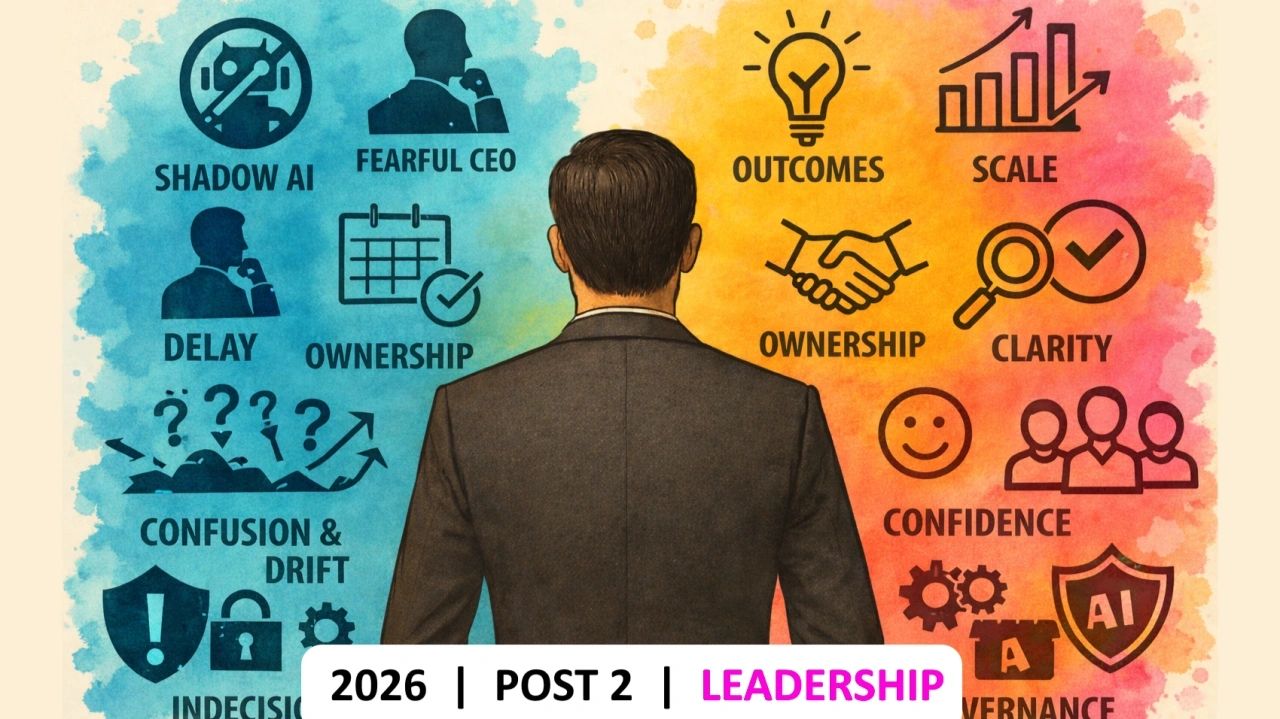
How hesitation at the top quietly shapes everything beneath it
By Rob, Founder of The Human CTO
I have been in a growing number of conversations lately where AI is technically present, but leadership is not. The decks look right, the language sounds confident, and the tools are already being discussed, yet nothing really moves. There is a pause in the room that is hard to name at first. It is not disagreement, and it is not a lack of intelligence. It is hesitation. A quiet sense that everyone is waiting for someone else to step forward and lead.
That pause is where stagnation lives. AI does not create it, but it exposes it. More than any technology shift I have worked through, AI has a way of revealing how leadership behaves when certainty disappears and when decisions can no longer be comfortably deferred.
Over time, I have started to notice the same patterns repeating across very different organisations. Different sectors, different scales, different levels of maturity, yet leadership responses to AI fall into familiar shapes. Not because the technology is the same, but because human behaviour at the top of organisations is remarkably consistent under pressure of the unknown or unnerved.
What follows are four AI leadership archetypes I see surfacing again and again.
The Unified Executive Team
AI held with both hands
Every now and then, you walk into a business and you can feel it almost immediately. AI is not being treated as a specialist topic or an awkward agenda item. It is not owned by IT, nor is it hidden away in an innovation lab where it can exist without consequence. It sits naturally in the flow of executive conversation, not as a threat, but as a capability that needs shaping.
In these organisations, the CEO does not talk about AI in terms of tools or trends. They talk about what they want the business to be better at. They talk about direction, competitiveness, and confidence in the decisions being made. The CFO does not reduce AI to a cost line or a vague efficiency promise. They talk about signal, margin protection, decision velocity, and the quality of financial insight. The COO frames AI through the lens of operational friction, human effort, and the invisible work that drains energy from teams every day. The CTO brings the grounding force, talking honestly about feasibility, data reality, architectural limits, risk, and timing.
What stands out is not that everyone understands AI deeply. It is that no one hides behind not understanding it. Questions are asked openly. Trade offs are discussed without theatre. Decisions are made with an acceptance that they will not be perfect, and that learning will follow.
In these businesses, AI does not feel disruptive. It feels inevitable and managed. It becomes part of how the organisation thinks, rather than something it nervously reacts to. Momentum does not come from the technology itself, but from the fact that leadership is aligned enough to carry uncertainty together.
The Lone CTO
Pushing uphill with intent
This is the pattern I see most often, and it is the one that carries the quietest strain.
A forward thinking CTO can see what is coming. They understand the cost of standing still and the risk of letting AI seep into the organisation without structure. They know that people are already experimenting, already relying on tools, already shaping decisions in small, ungoverned ways. They also know that once habits form, they are hard to unwind.
So they push. They translate AI into business language. They try to connect technical capability to real outcomes. They run pilots, explore guardrails, and attempt to bring shape to something that feels amorphous to everyone else. Often, they are doing this while still carrying the day job of keeping systems running and teams stable at the same time.
But without shared executive ownership, progress becomes fragile. AI sits at the edge of the organisation rather than at its centre. Initiatives exist, but they never quite scale. Every step forward requires explanation, justification, and defence. Each conversation feels like starting again.
This is not because the CTO is wrong. It is because leadership is incomplete. When AI is carried by one role alone, it becomes exhausting. Over time, even the most capable CTO will feel the weight of pushing uphill without reinforcement. AI without shared belief does not fail loudly. It simply gets forgotten, lost, runs wild, creates downstream risks which will bite back extremely fast in the new ‘AI GDPR’esk’ world we are now about to deal with.
The COO Under Pressure
Efficiency demanded AI before AI readiness existed.
In some organisations, AI enters through operational pain rather than strategic intent. The COO is dealing with relentless inefficiency. Manual workarounds have become normal. Teams are compensating for broken processes with goodwill and effort. The cost is not always visible on a spreadsheet, but it is felt every day in energy, morale, and missed opportunity.
In this context, AI looks like oxygen. There is a growing urgency to automate, to remove steps, to speed things up. Questions start to surface about why certain tasks still exist at all, and whether AI could simply take them away.
Sometimes this instinct is right. Often, it is premature. When AI is introduced purely as an efficiency lever, without clarity of purpose or readiness, it accelerates dysfunction rather than resolving it. Existing confusion moves faster. Poorly understood processes become harder to interrogate. Decisions are made quickly, but not necessarily well.
Here’s a real-world example: Ops used this AI tool on the side, let’s call it ‘DeepFind’. They used it to augment a finding during one of their processes, the process that outputs a letter to their customer. Ops are intuitive and lean by their very nature, and as such, found this highly productive when their shadow IT department, Bob, found a way of creating a prompt that, when pasted into ‘DeepFind’ with a whole customer record, generated this customer letter for them. Now, the letter was quite good in all honesty, but the process wasn’t. This was endorsed by Ops leaders as an immediate time-saving exercise and was widely cascaded. Then, 1 month later, after it had become the norm, ‘DeepFind’ was blocked. Technical and Risk information was cascaded, why its been blocked, and now a whole Ops department is having to not only unwind a loved process, but also explain why thousands of customer records have been shared externally overseas and how the ICO would like to understand how….
This wasn’t ‘DeepFind’.
His name wasn’t ‘Bob’.
But the rest is true.
You cannot automate clarity. You can only automate what already exists. When the underlying system is fragile, AI amplifies that fragility. This is where organisations find themselves moving faster while feeling less in control, mistaking activity for progress and just like the CTO format- “When AI is carried by one role alone, it becomes exhausting and risky.”
The Fearful CEO
AI kept at arm’s length
This archetype is frequently misunderstood and often unfairly judged.
Most CEOs I see in this position are not resistant to AI because they are uninterested or incapable. They are cautious because the stakes feel high and the uncertainty feels personal. AI touches reputation, trust, control, and accountability in ways that other technologies did not.
When confidence is missing, caution turns into avoidance. AI is postponed, parked behind policy, or framed as something to revisit later when the picture is clearer. The intention is often to protect the business.
But the business does not wait.
People find their own tools. Teams develop their own standards. Decisions begin to rely on AI outputs without shared understanding or oversight. Leadership, in trying to stay safe, slowly loses visibility.
Avoidance feels safe in the short term, but stagnation is far riskier than engagement. By the time leadership steps in, the shape of AI use has already been set without them.
What AI Is Really Exposing
Across all four archetypes, one thing becomes clear. AI is not replacing leadership. It is exposing it.
Indecision slows organisations far more than imperfect decisions ever have. When leaders hesitate, everyone else fills the gap differently. Different tools, different assumptions, different ethics. This is not governance. It is drift.
Strong AI leadership is not about technical fluency. It is about directional clarity. It is about deciding why AI exists in your organisation, where it is allowed to land, and staying present enough to adjust as reality changes.
AI does not need perfection. It needs leadership that shows up consistently, especially when the room feels uncomfortable and the answers are not obvious.
What I See Working When Organisations Break the Stalemate
One thing I should say clearly here is that leadership stagnation around AI is not permanent. I have seen organisations move through it. Not by buying better tools or hiring louder experts, but by changing how they think about readiness, ownership, and direction before anything technical really starts.
The shift usually begins when leadership stops asking “what can AI do for us?” and instead asks “what are we actually trying to be better at right now?” That sounds simple, but it is rarely asked with enough honesty. When it is, AI stops being abstract and starts becoming contextual. It becomes anchored to real business pressure, not future promise.
The next thing that changes is ownership. The organisations that move forward do not treat AI as an IT initiative or an innovation experiment. They treat it as a leadership capability that needs shared language. Before models, platforms, or automation, they create clarity around decision rights, acceptable risk, data boundaries, and human oversight. Not in policy documents that no one reads, but in conversations that align the executive team around what good looks like and what is off limits.
Another pattern I see consistently is a willingness to look inward before looking outward. Teams that progress pause to assess their own reality first. Where decisions are slow. Where confidence in data is low. Where people already rely on judgement calls because systems do not help them enough. AI is then introduced deliberately into those pressure points, not everywhere at once. This sequencing matters more than most people realise. When AI is focused on the moments that matter, trust builds quickly. When it is sprayed broadly, scepticism grows.
The most important shift, however, is human. Leaders who break the stalemate invest time in making sure people are actually ready to receive AI. Not trained on tools, but prepared for the change in how decisions are made, how work feels, and where accountability sits. They acknowledge fear without amplifying it. They make space for questions without letting them stall progress. They lead visibly, even when they are still learning themselves.
None of this requires a new platform. It requires discipline, sequencing, and the courage to slow down just enough to move forward with intent. When those pieces are in place, AI stops being a leadership problem and starts becoming a leadership amplifier.
Final Thought
AI is not causing leadership stagnation. It is simply revealing it.
The question is not whether AI will change how your organisation works. It already is. The real question is whether leadership will grow fast enough to carry the responsibility that comes with it.
Because when leadership does not step forward, AI still moves. It just does so without direction, belief, or trust. And that is where the real risk lives.

Living this right now?
Coaching is the shortest route through it.
One-to-one, in confidence, with someone who has done the job. Or just book a call and talk it through.